PPC Marketing for Travel Agencies: How to Get More Flight Bookings and Qualified Leads
 PPC Marketing Editorial Team
October 9, 2026
11 min read
PPC Marketing Editorial Team
October 9, 2026
11 min read
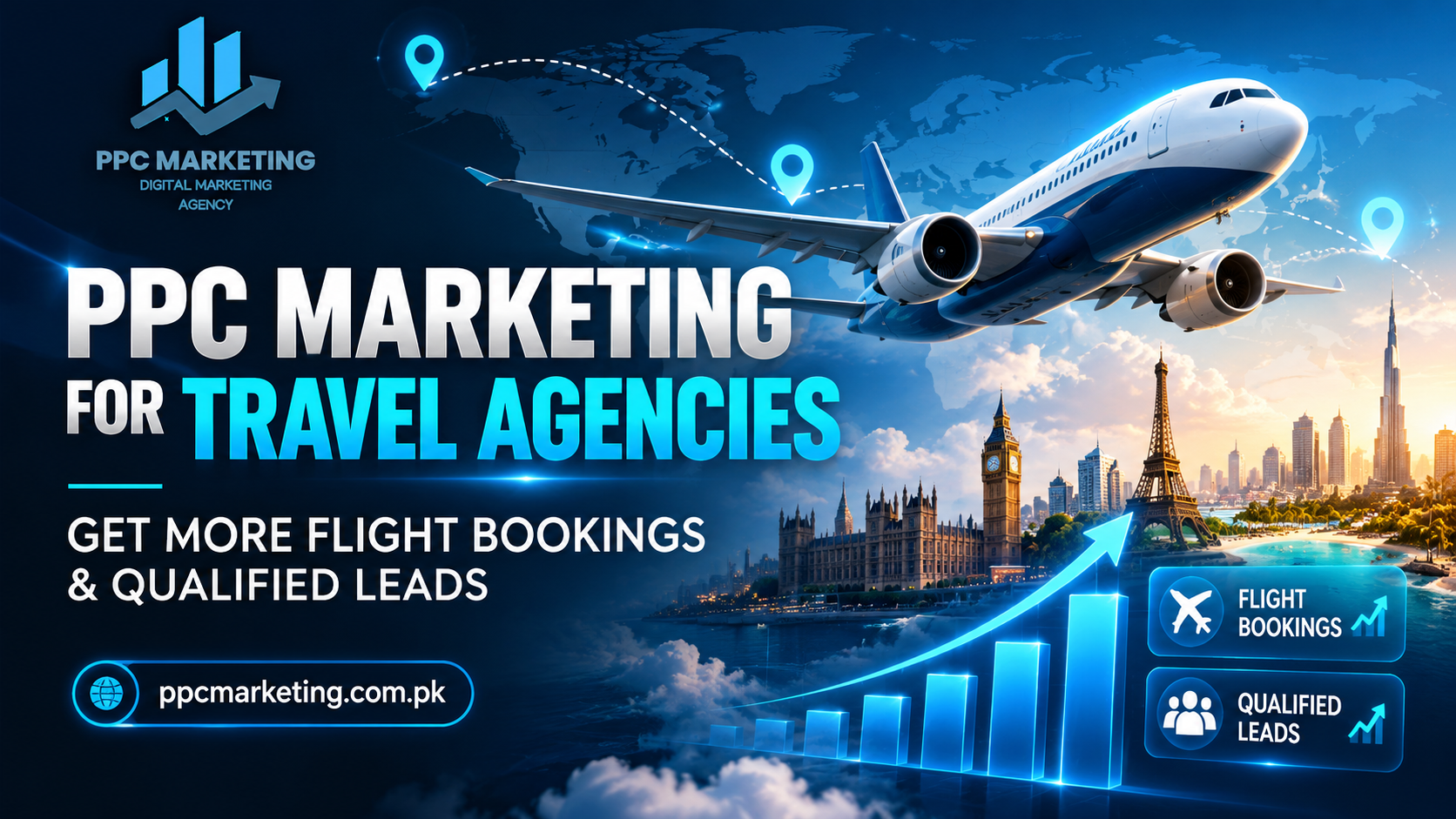
The travel industry is highly competitive. Whether you sell international flight tickets, holiday packages, Umrah packages, or business travel services, attracting customers at the right time can make a significant difference to your business growth.
Many travel agencies invest in digital marketing but struggle to generate consistent bookings. They receive website traffic without enquiries, spend money on advertising without understanding the results, or attract people who are not ready to book.
This is where PPC marketing for travel agencies can make a difference.
Pay Per Click (PPC) advertising helps travel businesses reach potential customers who are actively searching for flights, travel deals, and holiday packages. With the right campaign strategy, relevant landing pages, and accurate conversion tracking, travel agencies can attract qualified leads and turn more potential customers into paying clients.
At PPC Marketing, we help businesses develop strategic paid advertising campaigns designed to improve lead quality, reduce wasted ad spend, and support measurable growth. In this guide, we explain how travel agencies can use PPC marketing to generate more flight bookings and qualified leads.
What Is PPC Marketing for Travel Agencies?
PPC marketing is a form of online advertising in which advertisers typically pay when someone clicks on their advertisement. It allows travel agencies to promote their services across platforms such as Google Ads and Microsoft Advertising.
For example, a customer searching for "flights from London to Karachi" may be actively comparing airlines, prices, and travel agencies. A well targeted search advertisement can put your travel agency directly in front of that customer when they are actively looking for flight options.
Travel agencies can use PPC advertising to promote:
- International flight tickets
- Flights from the UK to Pakistan, India, Africa, and other global destinations
- Umrah and Hajj related travel services
- Holiday and family travel packages
- Corporate travel and business flights
- Last minute flight enquiries
- Group bookings and specialist travel services
The main objective is not simply to generate clicks. It is to attract the right audience and encourage meaningful actions, such as requesting a flight quotation, calling your reservation team, submitting a booking enquiry, or completing an online booking.
Why Is PPC Marketing Important for Travel Agencies?
Travel customers often compare several providers before making a booking. They may search on Google, visit multiple websites, check different airlines, and contact travel agents to find a suitable option. PPC advertising gives travel agencies an opportunity to compete for these customers at crucial moments in their buying journey.
1. Reach Customers Who Are Actively Searching for Flights
One of the major advantages of search advertising is the ability to target users based on relevant search queries. For example, a travel agency selling tickets to Pakistan might target searches such as:
- Flights to Pakistan from the UK
- Cheap flights from London to Lahore
- Flight tickets from Manchester to Islamabad
- Flights from Birmingham to Karachi
- Travel agent for flights to Pakistan
These searches indicate much stronger booking intent than broad searches about travel inspiration. By building campaigns around commercially relevant search terms, travel agencies can reach potential customers who are ready to enquire or book.
2. Generate More Flight Booking Enquiries
Not every customer books a flight directly online. Many travellers prefer to contact a travel agent for assistance with complex itineraries, family bookings, flexible dates, baggage allowances, or specialist travel arrangements.
PPC campaigns can direct these customers to useful landing pages with clear contact options, including:
- A relevant headline describing the exact route
- A simple flight enquiry form (departure, arrival, dates, passenger count)
- A prominent, clickable telephone number
- A direct WhatsApp enquiry button
- Clear instructions on how quickly quotations are delivered
3. Reach Customers in Specific Locations
Travel agencies often serve customers in particular countries, cities, or diaspora regions. With suitable campaign settings, advertisers can focus on locations that matter to their business. A travel agency serving UK customers, for example, may create separate campaigns for London, Manchester, Birmingham, and other key departure markets.
4. Measure Advertising Performance
PPC advertising provides access to detailed performance data. Depending on your tracking setup, your agency can measure clicks, impressions, cost per click, flight enquiry form submissions, qualified phone calls, WhatsApp enquiry clicks, confirmed bookings, and cost per qualified lead.
How to Build a Successful PPC Campaign for a Travel Agency
A profitable advertising campaign requires more than selecting a few keywords and setting a daily budget. Campaign structure, keyword intent, landing page relevance, bidding strategy, and conversion tracking all influence performance. Here is the step-by-step framework to develop a stronger travel PPC strategy:
Step 1: Identify Your Most Profitable Travel Services
Before launching a campaign, identify which services your business wants to promote and which offer the strongest commercial margins:
- Flights from the UK to Pakistan (Lahore, Islamabad, Karachi, Sialkot)
- Flights from the UK to India or African destinations
- Premium cabin and business class flight bookings
- Umrah and Hajj travel packages
- Group and family bookings
Consider average booking values, gross profit margins, operational staff capacity, and close rates. Focusing on higher-margin routes ensures your ad spend works efficiently.
Step 2: Conduct High-Intent Keyword Research
The aim is to identify searches that reflect genuine buying intent. For a travel agency selling flights from the UK to Pakistan, relevant keyword themes include:
- General flight searches: "Flights to Pakistan", "Flight tickets to Pakistan", "Flights to Pakistan from UK"
- Route-specific searches: "Flights from London to Karachi", "Flights from Birmingham to Lahore", "Manchester to Islamabad tickets"
- Travel agent searches: "Flight booking agent near me", "Travel agency for international flights", "Travel agent for flights to Pakistan"
- Specialist service searches: "Family flights to Pakistan", "Business class flights to Karachi", "Group flight bookings to Pakistan"
Use search term reports to continuously add negative keywords. Excluding searches for free games, unrelated visa questions, airline jobs, or flight tracker status checks prevents wasted budget.
Step 3: Organise Campaigns Around Destinations and Services
A common mistake is placing too many unrelated destinations and services into a single advertising campaign. A modular structure gives you better budget control and clearer reporting:
| Campaign Name | Primary Objective | Key Focus |
|---|---|---|
| Flights to Pakistan | Generate route booking leads | London, Manchester, Birmingham to ISB/LHE/KHI |
| Flights to India | Reach travellers to Indian hubs | Direct & connecting route searches |
| Umrah Packages | Attract religious travel enquiries | Flights + hotel packages from UK/Pakistan |
| Business Class Flights | Target high-margin luxury bookings | Corporate and premium cabin itineraries |
Step 4: Write Advertisements That Match Customer Intent
Your advertisements should explain what you offer, where you operate, and why a traveller should contact your agency. Avoid generic ads that could belong to any airline aggregator.
Headline: Flights to Pakistan from the UK | Fast Quotations
Description: Planning a trip to Pakistan? Contact our specialist travel team for competitive flight options, flexible dates, and family baggage allowances. Chat on WhatsApp or call today.
Step 5: Create Dedicated Landing Pages
Sending every advertisement to your generic homepage creates unnecessary friction. Someone searching for "flights from London to Karachi" should land on a page dedicated to London-Karachi flights with route details, baggage tips, a quote form, and instant WhatsApp chat.
Better landing page relevance significantly improves your Google Ads Quality Score, which lowers your Cost Per Click (CPC) and boosts conversion rates. Learn more about why poor landing pages hurt PPC ads.
Step 6: Optimise the Mobile Booking Experience
Over 70% of travel searchers research and contact travel agencies from smartphones. If your mobile website is slow or difficult to navigate, you lose potential bookings before they even reach out. Ensure:
- Enquiry forms are brief and easy to fill with auto-fill enabled.
- Phone numbers are clickable (`tel:` links).
- WhatsApp buttons trigger pre-filled route inquiries.
- Pages load in under 2.5 seconds on mobile 4G/5G connections.
Google Ads vs Meta Ads for Travel Agencies
Google Ads and Meta Ads both play important roles in travel marketing, but they address different stages of the customer buying journey:
- Google Search Ads (Capturing Existing Demand): Reaches people who have already decided they need a flight. Perfect for high-intent, immediate route searches like "tickets to Islamabad".
- Meta Ads (Generating Awareness & Demand): Reaches Facebook and Instagram users with eye-catching imagery, seasonal Umrah packages, and retargeting campaigns that bring past site visitors back to complete their quote.
How to Generate Qualified Leads Instead of Just Clicks
One of the biggest frustrations in travel advertising is receiving high click volumes that never convert into bookings. To attract commercially valuable leads:
- Use Exact and Phrase Match Keywords: Avoid overly broad match terms that match casual travel research.
- Incorporate Route Specifics into Ad Text: Clearly state departure and destination locations so irrelevant searchers don't click.
- Ask Strategic Form Questions: Include departure city, destination, travel dates, passenger count, and journey type (one-way vs return).
- Qualify Offline Enquiries: Review which leads actually pay deposits and feed this data back into your bidding strategies.
Conversion Tracking: The Foundation of PPC Optimisation
Without reliable conversion tracking, it is impossible to determine whether advertising generates real business returns. For travel agencies, tracking must go beyond simple page views:
- Flight enquiry submissions: Track successfully submitted quote requests.
- Qualified phone calls: Measure inbound phone calls that last longer than 60–90 seconds.
- WhatsApp enquiry clicks: Measure users who click through to start a conversation.
- Confirmed offline bookings: Connect CRM booking receipts back to campaign keyword data.
How Much Should a Travel Agency Spend on PPC Advertising?
There is no universal budget. The right budget depends on route competition, average ticket margins, and conversion rates. To evaluate feasibility, calculate your target customer acquisition cost:
• Monthly PPC Ad Spend: £600
• Total Inquiries Received: 30 leads (£20 Cost Per Enquiry)
• Confirmed Bookings Closed: 5 bookings
• Advertising Cost Per Confirmed Booking: £600 ÷ 5 = £120
If your gross profit per booking exceeds £120, your campaign is generating positive revenue before operational costs.
Common PPC Mistakes Travel Agencies Should Avoid
- Targeting Too Many Broad Keywords: Dilutes budget on casual searchers.
- Sending Traffic to the Homepage: Confuses users who searched for a specific destination.
- Neglecting Negative Keywords: Paying for queries like "free baggage", "airline jobs", or "flight radar".
- Optimising for Clicks Rather Than Bookings: Misleading vanity metrics that don't pay business overhead.
- Untested Conversion Tracking: Double-counting form submissions or misinterpreting WhatsApp clicks.
- Changing Settings Too Frequently: Not allowing Google's smart bidding algorithms sufficient time to learn.
- Slow Lead Follow-Up: Inquiries grow cold within hours. Follow up on travel leads within 15 minutes.
Should Travel Agencies Use Performance Max Campaigns?
Google Performance Max (PMax) campaigns can be powerful when paired with strong first-party customer lists, high-quality video/image assets, and established conversion tracking. However, PMax should not replace core Google Search campaigns. Search campaigns provide precise keyword control, negative keyword lists, and search term transparency that are crucial for specific flight route bidding.
How PPC Marketing and SEO Work Together for Travel Agencies
PPC provides immediate search visibility and test data, while SEO builds sustainable, compounding organic visibility over time. High-converting keywords identified through your Google Ads campaigns can guide your long-term organic content strategy, while strong SEO pages reduce your blended cost per customer acquisition across both channels.
Ready to Scale Your Travel Agency's Flight Bookings?
Partner with PPC Marketing to build structured Google Ads and paid advertising campaigns designed to generate qualified flight enquiries and maximize your return on ad spend.
Frequently Asked Questions About Travel PPC
What is the best PPC platform for travel agencies?
Google Ads is generally the strongest platform for capturing customers actively searching for flight routes and travel booking services. Meta Ads (Facebook & Instagram) are highly effective for seasonal holiday packages and visual retargeting.
How can travel agencies get more flight bookings through Google Ads?
By targeting high-intent route keywords, building route-specific landing pages, writing transparent ad copy, and setting up rapid WhatsApp and phone inquiry responses.
How much does PPC advertising cost for a travel agency?
Costs depend on route competition and destination demand. Agencies should begin with a focused budget targeting their most profitable routes, monitor their cost per confirmed booking, and scale up profitably.
How do you measure PPC success for a travel agency?
Focus on qualified inquiries, cost per lead, confirmed bookings, customer acquisition cost, and gross profit generated—rather than simple clicks and impressions.
Is PPC better than SEO for travel agencies?
PPC delivers immediate traffic and rapid testing data, while SEO builds lasting organic authority over 3 to 6 months. Combining both channels provides the highest market share and lowest blended acquisition cost.
Can PPC marketing generate WhatsApp enquiries for travel agencies?
Yes. Mobile flight landing pages with sticky WhatsApp buttons are among the highest-converting lead channels for UK-to-Pakistan and international flight bookings.
How can travel agencies reduce wasted Google Ads spend?
Consistently review search term reports, add negative keywords, tighten location targeting to realistic service areas, and avoid driving paid traffic to generic homepages.